

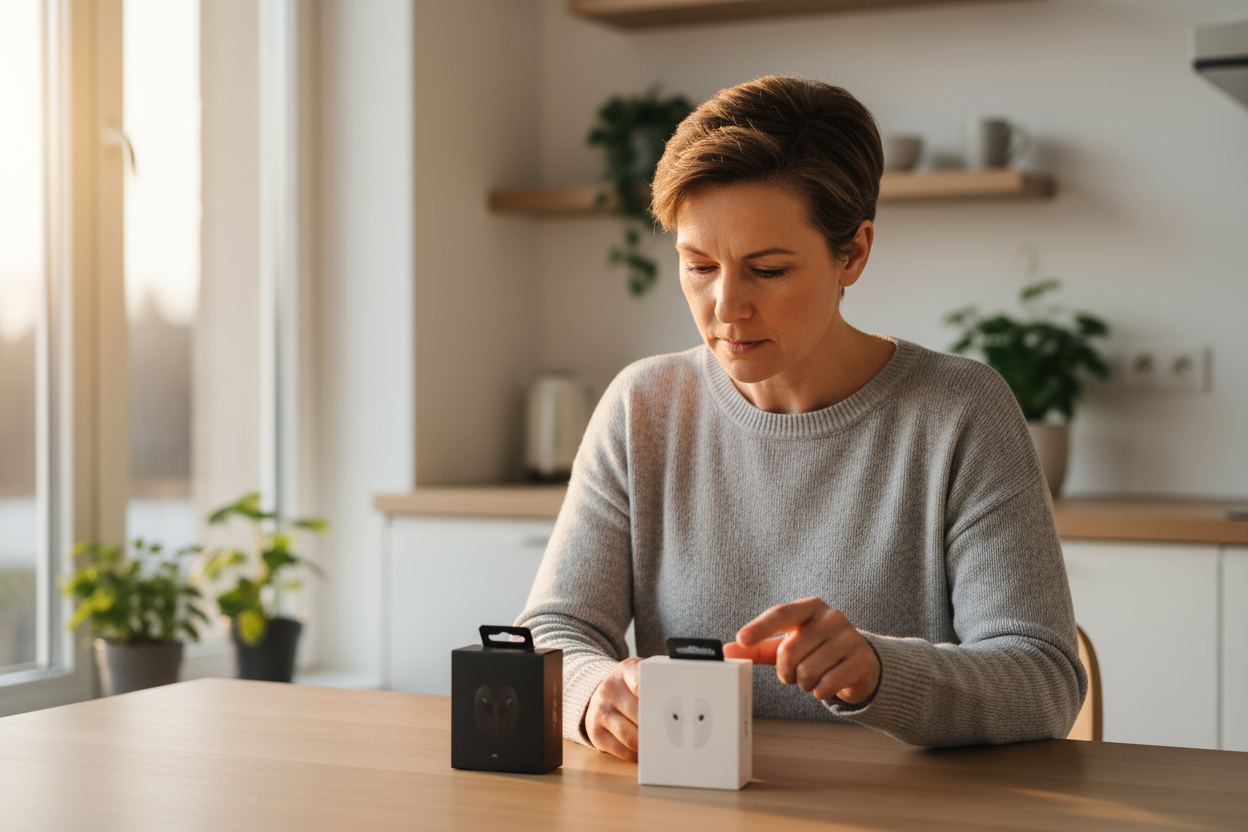
OTC vs Prescription Hearing Aids: Which Is Right for You?
Since the FDA formally established the over-the-counter hearing aid category in October 2022, millions of Americans have gained access to hearing devices without needing a doctor's appointment or a four-figure price tag. But that also created a new dilemma: when should you choose OTC, and when does a prescription device make more sense?
The honest answer is that it depends on your degree of hearing loss, your lifestyle, your budget, and how much you value professional guidance. This article breaks down each factor plainly so you can make a confident decision.
The Core Difference: Who They're Designed For
This is the most important distinction, and it's defined by the FDA.
OTC hearing aids are designed for adults (18+) with perceived mild to moderate hearing loss. You self-assess your hearing, buy the device, and fit it yourself — no professional required.
Prescription hearing aids are designed for all levels of hearing loss, including severe and profound. A licensed audiologist tests your hearing, selects the appropriate device, programs it to your specific audiogram, and provides ongoing care.
If your hearing loss is mild to moderate, both routes are potentially viable. If your loss is severe or profound, OTC hearing aids simply won't provide enough amplification — prescription is the right path.
Head-to-Head Comparison
Cost
This is where OTC hearing aids have a decisive advantage.
OTC hearing aids: $150–$399/pair for most quality mid-range devices; entry-level starts lower, premium audiologist-backed brands run higher
Prescription hearing aids: $2,000–$7,000+/pair, including professional fitting and follow-up
The average prescription hearing aid costs around $1,700 per device — nearly $3,400 for a pair — and that often doesn't include the full cost of the audiologist's fitting services, follow-up appointments, or annual maintenance fees.
OTC hearing aids eliminate the professional services component entirely. You pay for the device, full stop.
If budget is the primary barrier between you and better hearing, OTC hearing aids exist specifically to address that gap.
Professional Fitting and Customization
Prescription: An audiologist performs a comprehensive hearing evaluation (audiogram), identifies the exact type and degree of your hearing loss, selects a device appropriate to your audiogram, and programs it to match your specific loss at each frequency. Follow-up visits allow for fine-tuning. This is the gold standard.
OTC — Self-Fitting: Uses a smartphone app to run a brief hearing test and automatically adjusts settings based on the results. It's not as precise as a professional audiogram, but it provides meaningful personalization without a clinic visit.
OTC — Preset: Offers a small number of fixed amplification profiles (e.g., quiet room, noisy environment, general use). No app, no test — you choose the program that feels most helpful. Simple, but less tailored.
If your hearing loss is straightforward (bilateral, gradual, high-frequency — the most common pattern), self-fitting OTC devices often come surprisingly close to what an audiologist-fitted device achieves. For more complex loss patterns, prescription remains superior.
Ongoing Support and Care
Prescription: Your audiologist is a long-term partner — available for adjustments, cleanings, troubleshooting, and monitoring changes in your hearing over time. If your hearing loss progresses, they can reprogram your devices.
OTC: Support varies by brand. Some OTC companies offer phone and video support with hearing care professionals; others offer only online FAQs. If your needs are simple and you're tech-comfortable, this is manageable. If you anticipate needing significant hand-holding, build that into your decision.
Availability
OTC: Available immediately, online or in stores, without an appointment. You can order today and have them by the end of the week.
Prescription: Requires scheduling, attending, and waiting for an audiologist appointment. In many regions — particularly rural areas — wait times can be weeks. Then there's time for fitting, programming, and follow-up.
For people who've been putting off addressing their hearing loss because the process feels overwhelming, OTC significantly lowers the barrier.
Range of Hearing Conditions Addressed
OTC: FDA-limited to mild and moderate hearing loss. Not suitable for severe/profound loss, single-sided deafness, or complex audiological conditions.
Prescription: Can address all levels of hearing loss, including severe and profound. Audiologists can also identify and refer for medical conditions that may be contributing to hearing loss.
When OTC Hearing Aids Are the Right Choice
You're a strong candidate for OTC hearing aids if:
- Your hearing loss is self-perceived as mild to moderate
- You struggle mainly in noisy environments, on the phone, or in group conversations
- You can follow most conversations in quiet one-on-one settings
- You're comfortable using a smartphone (for self-fitting models)
- Cost is a significant factor in your decision
- You'd rather avoid the time commitment of multiple clinic appointments
- You're curious about hearing aids but not sure if you'll stick with them
OTC hearing aids also make sense as a first step. If you try them and find significant benefit, great. If you try them and find they're not quite enough, you've gathered useful information about your needs before investing in a prescription device.
The "Entry Point" Reality
Research from MarkeTrak 2025 found that OTC hearing aids are increasingly serving as a gateway into hearing health — with 38% of OTC users intending to switch to traditional hearing aids for their next purchase. This isn't a failure of OTC; it's the system working. OTC gets people into the habit of wearing hearing aids and addressing their loss, making them more likely to seek better solutions as their needs evolve.
When Prescription Hearing Aids Are the Right Choice
You should go directly to an audiologist if:
- You've already tried OTC hearing aids and they haven't provided enough help
- You suspect your hearing loss is more than moderate (difficulty hearing even in quiet rooms, inability to hear loud sounds)
- Your hearing loss is significantly different between ears
- Your hearing loss appeared suddenly (weeks or months rather than gradually over years)
- You have tinnitus in one ear only, or alongside dizziness or ear pain
- You have a history of ear infections, surgery, or ear abnormalities
- You work in a demanding hearing environment (music, teaching, courtroom, etc.) and need highly optimized performance
- You're under 18 — OTC hearing aids are not approved for minors
The Gray Area: Moderate Hearing Loss
Mild hearing loss is clearly in OTC territory. Severe hearing loss is clearly in prescription territory. Moderate hearing loss — the 41–55 dB range — is where the decision gets nuanced.
Some people with moderate hearing loss do very well with high-quality OTC self-fitting devices, particularly if their loss is symmetrical and primarily affects high frequencies. Others find OTC insufficient, especially if their loss is uneven across frequencies or involves more complex patterns.
If you're in this range, here's a practical approach:
- Start with a quality OTC self-fitting device that has a solid return policy (30+ days)
- Give it 4–6 weeks of consistent use across different environments
- Evaluate honestly: Are conversations easier? Is listening fatigue reduced? Are you using them every day?
- If yes — great. If no — take your experience to an audiologist. Knowing what OTC didn't solve helps them find the right prescription solution faster.
Does Insurance Cover Either Option?
Neither OTC nor prescription hearing aids are covered by Medicare Parts A and B. Medicare Advantage (Part C) plans may include hearing benefits — check your specific plan. Private insurance coverage is inconsistent.
FSA and HSA accounts can typically be used to purchase either type.
The cost advantage of OTC becomes even more pronounced when you factor in that neither type is usually covered.
→ Full insurance and cost guide: Does Insurance Cover OTC Hearing Aids?
A Quick Decision Framework
Answer these three questions:
-
Do you have difficulty hearing even in quiet, one-on-one settings (not just noise)?
→ Yes: Consider seeing an audiologist first
→ No: OTC is a reasonable starting point -
Have you had any sudden hearing changes, ear pain, drainage, or one-sided symptoms?
→ Yes: See a doctor before buying any hearing device
→ No: Continue -
Is cost a significant constraint?
→ Yes: OTC is specifically designed for your situation
→ No: Professional fitting might be worth the investment for optimal results
Frequently Asked Questions
Can OTC hearing aids be as good as prescription ones?
For mild to moderate, symmetrical high-frequency hearing loss — which is the most common pattern — high-quality OTC self-fitting devices often come close to prescription performance. For more complex loss patterns, prescription devices remain superior.
Can I switch from OTC to prescription later?
Yes. Many people use OTC first, then upgrade to prescription hearing aids as their hearing needs change. There's no downside to starting with OTC.
Do OTC hearing aids require any professional involvement at all?
No — but many OTC brands offer optional remote consultations with audiologists or hearing care professionals, often at no extra cost. This can help you get better results from a self-fitting device.
Are OTC hearing aids lower quality than prescription ones?
Not necessarily. Several OTC hearing aids use the same underlying acoustic technology as prescription devices. The difference is mainly in the level of customization and the complexity of conditions they're designed for — not fundamental quality.
What if my hearing loss gets worse over time?
OTC devices from reputable brands can often be recalibrated via their apps as your needs change. Beyond a certain point, you'll want professional reassessment. This is one reason ongoing audiologist relationships have value for people with progressive hearing loss.
Not sure which path is right for you? Our OTC hearing aids include a 30-day trial — no risk, no commitment, and support if you need it.
→ Shop OTC Hearing Aids
Related reading:
- OTC Hearing Aids: The Complete Buyer's Guide
- Do I Need a Hearing Aid? 8 Signs to Watch For
- How Much Do OTC Hearing Aids Cost?
Share:
Do I Need a Hearing Aid? 8 Signs You Shouldn't Ignore
Can You Buy Hearing Aids Without a Prescription? (Yes — Here's What You Need to Know)